
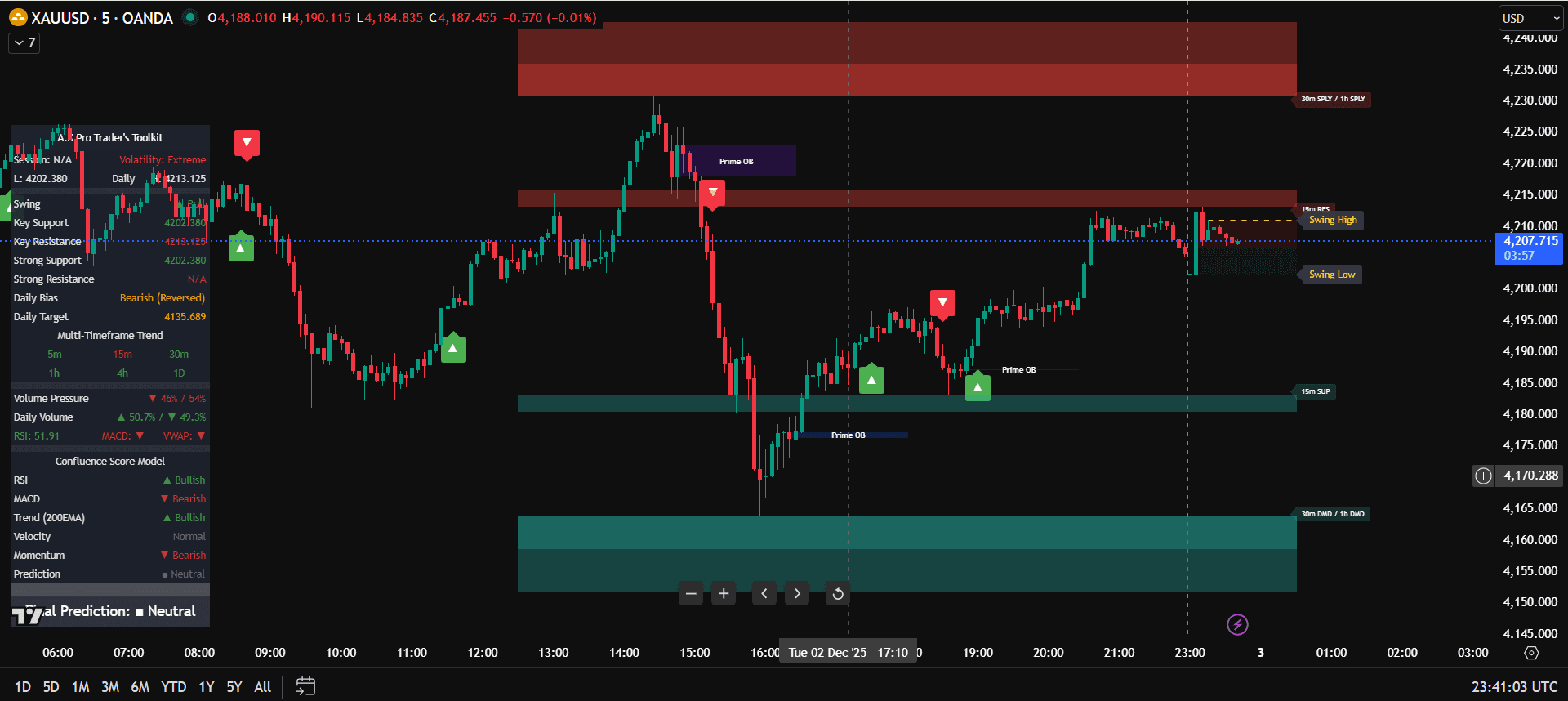
Risk Management Trading Strategy for Beginners
A strong risk management trading strategy protects your account before any TradingView indicator, signal, or entry model matters. The goal is simple: define the trade risk, place the stop where the idea is invalid, calculate position size correctly, and stop trading before one emotional session damages the account.
This guide is built for beginners and traders using indicator strategies, Forex pairs, and XAUUSD. It gives you a practical risk management trading strategy you can repeat with A.K Pro Traders indicators, Smart Money Concepts, key levels, or any structured TradingView workflow.
This risk management plan works best with a multi timeframe analysis strategy because higher-timeframe levels should be mapped first, so the stop-loss, invalidation point, and target all come from the same trading plan.
Quick answer: a clean risk management trading strategy starts with fixed risk per trade, stop-loss placement beyond invalidation, correct position sizing, daily max loss limits, and a rule to stop trading when the plan is broken.
What is a risk management trading strategy?
A risk management trading strategy is the set of rules that controls how much you can lose before you enter a trade. It covers risk percentage, stop-loss location, position size, maximum daily loss, and when to stop trading.
A trading strategy tells you where opportunity might be. A risk management strategy tells you how much damage is allowed if that opportunity fails. Without that second part, even a good indicator strategy can lose money because the trader risks too much, moves stops, or keeps trading after the plan is broken.
Risk management trading strategy for beginners
Beginners should keep risk management simple and mechanical. Do not change risk because you feel confident, angry, or desperate to recover a loss. The easiest beginner model is to risk a fixed small amount, use one clear stop-loss rule, and stop trading when the daily limit is reached.
1) Risk a fixed percentage per trade
Many traders keep risk small, such as 0.5% to 1% per trade. The exact number matters less than keeping it consistent.
2) Place the stop where the trade is wrong
The stop-loss should go beyond the level that invalidates the setup, not at a random pip distance.
3) Calculate position size after the stop
First choose the invalidation point. Then adjust lot size so the money risk stays fixed.
4) Use a daily max loss
Stop after a planned limit, such as two losing trades, 2R down, or a fixed percentage loss.
Risk management for TradingView indicator strategies
Indicators can help identify entries, structure, liquidity, and trend conditions, but they cannot control account risk for you. A TradingView indicator strategy still needs rules for stop placement, position sizing, trade frequency, and when to stand aside.
- Use indicators as context, not permission to risk more.
- Filter weak signals when higher-timeframe structure or session conditions are poor.
- Keep the same risk model whether the signal looks perfect or average.
- Review losses by process, not only by profit or loss outcome.
Stop-loss placement and trade invalidation
The stop-loss should represent the point where your trade idea is no longer valid. If the trade is based on a liquidity sweep, the stop usually belongs beyond the sweep. If it is based on structure, the stop should be beyond the structure point that proves the idea wrong.
- For structure trades, place the stop beyond the swing high or swing low that invalidates the idea.
- For liquidity sweep trades, place the stop beyond the sweep extreme.
- For key-level trades, place the stop beyond the full reaction zone, not inside the noise.
- For XAUUSD, avoid tiny stops when volatility is expanding around London, New York, or USD news.
Position sizing in a risk management trading strategy
Position sizing is where many traders make the biggest mistake. They choose lot size first and then try to fit a stop around it. A safer process is the opposite: choose the stop-loss from the chart, then calculate the lot size from the amount you are willing to lose.
- Find the setup and confirm it matches your plan.
- Mark the invalidation point on the chart.
- Measure the stop-loss distance.
- Calculate the position size from fixed account risk.
- Skip the trade if the stop is too wide or the reward is too weak.
For Gold traders, the XAUUSD position size calculator helps keep the money risk consistent when Gold volatility changes.
Daily max loss and weekly risk limits
A risk management trading strategy is not only about one trade. It also protects you from the damage caused by overtrading, revenge trading, and trying to win everything back in one session.
- Daily max loss: stop trading after a defined loss threshold.
- Max attempts: limit the number of trades in one session.
- Weekly guardrail: reduce size or pause after a multi-day losing streak.
- No revenge trading: once the rule is hit, the platform closes for the day.
Risk management for Forex and XAUUSD trades
Forex pairs and XAUUSD need different risk awareness because volatility, spreads, and session behaviour are not the same. Gold can move faster than many major pairs, especially around the London open, New York open, CPI, NFP, and FOMC.
Forex risk rule
Respect spread, session liquidity, and pair volatility. Do not use the same pip stop on every pair.
XAUUSD risk rule
Give Gold enough room beyond real invalidation, then reduce lot size so the account risk remains fixed.
If you trade Gold specifically, pair this risk model with the XAUUSD trading strategy and the XAUUSD Smart Money Concepts strategy guide so your execution and risk plan work together.
Real risk management trading strategy examples
Examples make risk control easier to follow because the rule becomes specific before the trade starts. These are educational scenarios, not trade signals. The point is to show how fixed risk, stop-loss placement, and position sizing work together.
Example 1: XAUUSD stop-loss and lot-size control
Gold gives a setup with a 45-point stop beyond real invalidation. Instead of using the same lot size as yesterday, the trader calculates position size from fixed account risk. If the stop is wider because volatility expanded, the lot size becomes smaller so money risk stays the same.
- Setup rule: stop goes beyond the structure point that proves the trade wrong.
- Risk rule: risk stays fixed even when Gold volatility changes.
- Decision: skip the trade if reward-to-risk is no longer attractive.
Example 2: Indicator signal filtered by daily loss limit
A TradingView indicator gives another entry after two losing trades. The signal may look good, but the daily loss rule has already been hit. The correct risk management decision is to stop trading, review the session, and protect capital instead of trying to win everything back.
- Setup rule: the signal is ignored once daily max loss is reached.
- Risk rule: no revenge trades after the planned limit.
- Decision: return tomorrow with the same written process.
Risk management trading strategy edge cases
Edge cases are the situations where traders usually break the plan. A strong risk management trading strategy tells you what to do before emotion appears.
The stop-loss becomes too wide
If the correct invalidation point makes the position too large or the reward too small, reduce size or skip. Do not pull the stop closer just to make the trade fit.
A high-impact news candle expands spread
CPI, NFP, FOMC, and rate comments can create slippage and false breaks. Stand aside or reduce risk until the candle settles and structure becomes clearer.
Three small losses happen in one session
A losing streak does not mean the next signal should be bigger. The rule is to stop, review screenshots, and protect the account from emotional decision-making.
The signal fights higher-timeframe context
When the signal fights H4 or H1 structure, lower risk or skip. Risk control includes filtering poor-quality conditions, not only calculating lot size.
Common risk management mistakes traders make
- Taking every indicator signal instead of filtering for higher-quality context.
- Using the same lot size on every market regardless of volatility.
- Moving stop-loss to avoid being wrong.
- Increasing size after a loss to recover quickly.
- Ignoring session conditions, spread expansion, and news volatility.
- Continuing to trade after the daily max loss has already been reached.
Risk management trading strategy checklist
- The setup matches my written trading plan.
- The stop-loss is placed where the idea is invalid.
- The position size matches fixed account risk.
- The trade still makes sense after spread and volatility.
- I know my maximum loss for the day before I enter.
- I will not move the stop-loss unless the plan says so.
- I will stop trading when my daily loss rule is triggered.
FAQ: Risk management trading strategy
What is a risk management trading strategy?
A risk management trading strategy is a set of rules for risk per trade, stop-loss placement, position sizing, daily loss limits, and when to stop trading.
How much should I risk per trade?
Many traders risk 0.5% to 1% per trade, but the most important part is using a fixed amount that you can repeat without emotional decision-making.
Where should I place my stop-loss?
Place the stop-loss beyond the chart level that invalidates the setup, such as structure, a sweep extreme, an order block boundary, or a key reaction zone.
Why do indicator strategies fail even with good entries?
Indicator strategies often fail because traders use poor position sizing, move stops, overtrade, or ignore daily loss limits. Good entries cannot fix bad risk control.
Is risk management different for XAUUSD?
Yes. XAUUSD can move fast and spreads can widen around news, so Gold traders should place stops beyond real invalidation and reduce lot size when volatility expands.
What is the biggest risk management mistake?
The biggest mistake is increasing risk after losses. This turns one normal losing trade into emotional damage and can quickly break an otherwise good strategy.
How do I calculate position size before a trade?
Choose the invalidation point first, measure the stop-loss distance, then calculate lot size from the fixed amount you are willing to lose. Do not choose lot size first.
When should I skip a trade even if the indicator gives a signal?
Skip when the stop is too wide, higher-timeframe context is unclear, major news is close, or your daily loss limit has already been reached.
All A.K Pro Traders content and indicators are provided for educational and informational purposes only and do not constitute financial, investment or trading advice. Trading leveraged products such as forex, commodities and indices involves substantial risk. Always use appropriate risk management and make your own trading decisions.
Related links
Continue your learning with the most relevant indicator overview and plan options.
General Risk Disclaimer
All A.K Pro Traders content and indicators are provided for educational and informational purposes only and do not constitute financial, investment or trading advice. Trading leveraged products such as forex, indices, commodities and crypto involves substantial risk. Always perform your own research, use appropriate risk management and consider speaking with a licensed financial professional before making any trading or investment decisions.