
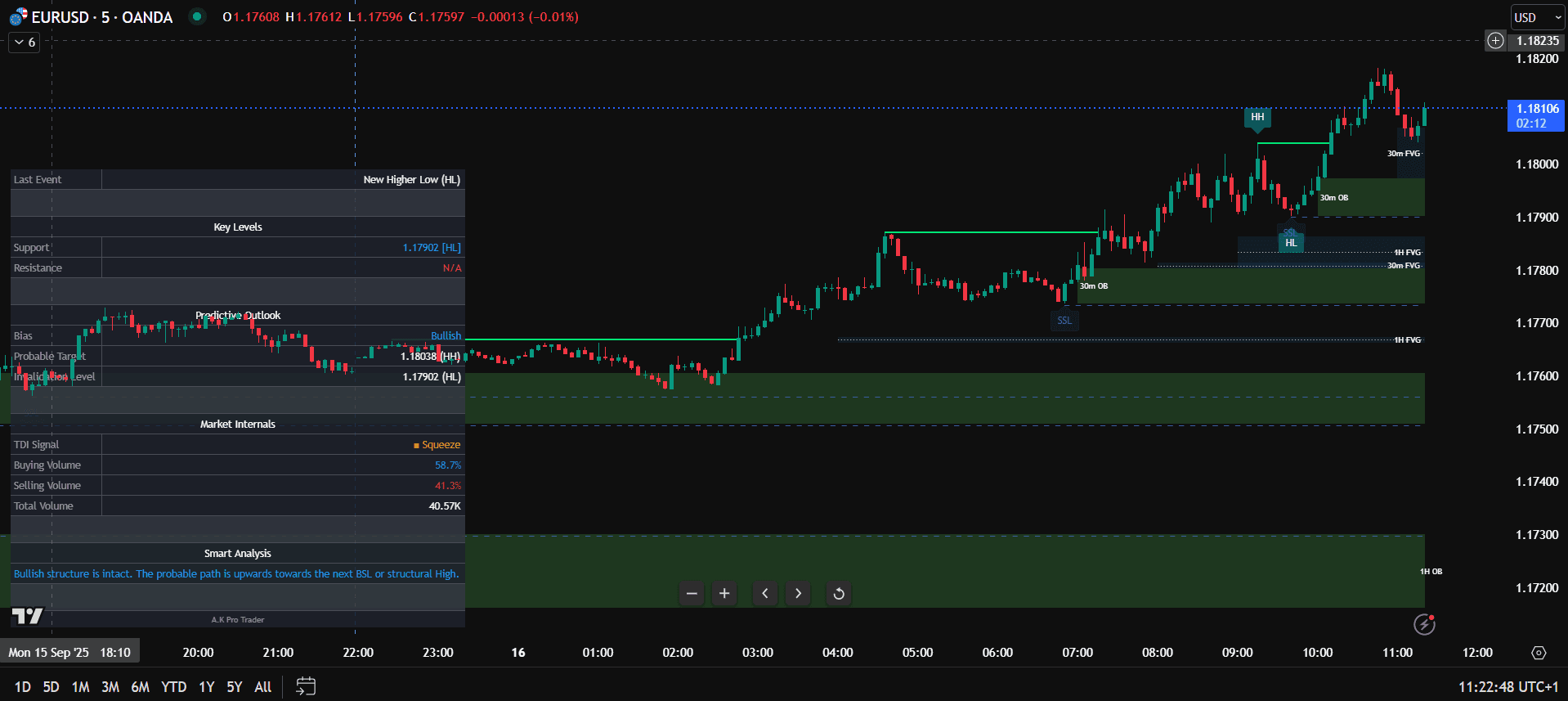
Why 90% of XAUUSD Traders Fail (and how SMC fixes it on TradingView)
If you've ever felt like XAUUSD (Gold) is "out to get you", you're not imagining things — you're experiencing how Gold actually trades. XAUUSD is volatile, it moves in bursts, and it has a habit of taking obvious highs and lows before running in the real direction. That behaviour is not random. It's where liquidity sits — and liquidity is what drives execution for larger participants.
The painful truth is that most retail traders approach Gold like a slow-moving Forex pair: they chase momentum after the move, they place stops at the most obvious swing points, and they rely on lagging signals (RSI / MACD crossovers) to tell them what already happened. The result is predictable: death by a thousand stop-outs, followed by revenge trading. If your chart setup is still messy, follow the A.K Pro Traders indicators setup guide first, then come back to this SMC TradingView workflow.
This guide is built for traders who want an institutional-style lens on Gold usingSmart Money Concepts (SMC) on TradingView: market structure (BOS/CHOCH), liquidity sweeps (BSL/SSL), order blocks, fair value gaps (FVGs), and a risk-first execution checklist.
Educational content only. Trading XAUUSD involves significant risk. Always use strict risk management.
1) The XAUUSD Trap: why Gold punishes retail behaviour
When traders say "Gold is manipulated", what they're usually describing is liquidity behaviour. Gold tends to respect obvious levels — not because it's friendly, but because those levels collect predictable retail orders: breakout entries above highs, stops below lows, and limit orders around round numbers.
The three most common XAUUSD mistakes
- Chasing after displacement: price expands, RSI looks strong, traders buy the top — and the market retraces into the real point of interest.
- Placing stops at the obvious swing: stops cluster under equal lows or above equal highs. Those pools get raided frequently.
- Trading without a framework: if you don't know bias, target liquidity, and invalidation, you're reacting — not executing.
Gold moves fast because it often reprices around key liquidity events. Instead of asking "is RSI overbought?" ask: where is liquidity resting, and what structure shift confirms the direction?
2) Smart Money Concepts: the SMC lens that makes Gold readable
Smart Money Concepts (SMC) is not magic — it's a framework for reading price action through structure and liquidity. On TradingView, an SMC workflow helps you answer three questions:
- Bias: are we trending bullish or bearish on the higher timeframe (H4/H1)?
- Liquidity target: which obvious highs/lows are likely to be taken (BSL/SSL)?
- Confirmation: what structure event proves a shift (CHOCH) or continuation (BOS)?
BOS vs CHOCH (Gold version)
Traders confuse these, then wonder why they enter at the wrong time. Here's the clean way to think about it:
- Break of Structure (BOS): continuation. In an uptrend, BOS = price breaks a prior swing high and holds structure (higher highs / higher lows).
- Change of Character (CHOCH): early reversal signal. In an uptrend, CHOCH often appears when price breaks a protected swing low after a liquidity raid.
On Gold, the highest-quality reversals usually follow the same rhythm: liquidity sweep → displacement → new structure confirmation. SMC gives you the language for that rhythm.
3) The Confluence Ritual: a repeatable SMC execution model for XAUUSD
Most traders don't fail because they lack information — they fail because they lack a repeatable model. A model removes emotion. Below is a clean SMC structure you can execute on TradingView every day.
Step A: Define HTF bias (H4/H1)
- Mark the most recent obvious swing high and swing low (the current dealing range).
- Decide the narrative: are we making HH/HL (bullish) or LL/LH (bearish)?
- Identify the next liquidity pool: prior day high/low, equal highs/lows, or a clean weekly level.
Step B: Wait for the raid (BSL/SSL)
You don't need to predict the raid — you need to recognise it. A raid is simply price taking an obvious high/low and then failing to continue. That failure is your first clue.
Step C: Look for displacement + FVG
After the raid, you want to see strong intent: a sharp move away (displacement) that leaves animbalance / Fair Value Gap (FVG). The FVG is not the entry by itself — it's the footprint that tells you the move had real energy behind it.
Step D: Choose a POI: OB + FVG overlap
- Prefer a clean order block that aligns with the displacement candle.
- If you can stack order block + FVG in the same zone, your POI is stronger.
- Be strict: if the POI is wide and messy, size down or skip.
Step E: Confirm on M15/M5 (CHOCH/BOS)
Confirmation keeps you out of the "catching knives" trap. On the execution timeframe, wait for a clearCHOCH (reversal) or BOS (continuation) and then take the retest into your POI.
If you want the cleanest workflow, keep it simple: HTF bias → liquidity raid → displacement → POI → confirmation → retest entry. If one step is missing, your edge is weaker.
4) Where indicators actually help (and where they don't)
A good TradingView indicator should do two things: reduce chart noise and standardise your process. What it should not do is replace your decision-making. With SMC, the indicator's job is to highlight structure events and points of interest so you can focus on execution quality.
What to automate
- Marking swing/internal structure (BOS/CHOCH) consistently.
- Highlighting liquidity pools (BSL/SSL) and equal highs/lows.
- Drawing FVGs and keeping POIs visible without clutter.
What you must still do
- Choose the setup you trade (continuation vs reversal) and stick to it.
- Define invalidation logically (beyond the structure that proves you wrong).
- Control risk and stop after hitting your daily loss limit.
Image tip (for your editor): add a WebP screenshot showing a liquidity sweep + displacement into an FVG retest on XAUUSD. Use alt text like"XAUUSD SMC Indicator Liquidity Sweep Chart - AK Pro Traders".
5) Risk management: the part that decides whether you survive Gold
Here's the part most traders ignore: even a perfect SMC entry will fail sometimes. Gold can spike, spreads can widen around news, and volatility can expand suddenly. The traders who survive are not the ones with the most indicators — they are the ones with fixed risk.
A simple professional rule-set
- Risk a small fixed percentage per trade (many serious traders use 0.25%–1%).
- Set a daily max loss (example: 2R or 2% — pick one and obey it).
- Only increase size after consistency, not after a lucky streak.
If your stop is correct but your lot size is wrong, you still lose. Use theXAUUSD Position Size Calculatorwith the risk management trading strategy guide to keep your risk fixed and professional on every Gold trade.
FAQ: XAUUSD SMC TradingView Strategy
These answers cover the main beginner questions for an xauusd smc tradingview strategy for beginners, including liquidity sweeps, BOS/CHOCH confirmation, order blocks, fair value gaps, stop placement, news risk, and daily setup selection.
What is an XAUUSD SMC TradingView strategy?
An XAUUSD SMC TradingView strategy is a structured way to trade Gold using Smart Money Concepts on TradingView, including higher-timeframe bias, liquidity sweeps, BOS, CHOCH, order blocks, fair value gaps and fixed risk.
Is the XAUUSD SMC TradingView strategy good for beginners?
Yes. Beginners should keep it simple by using H4 or H1 for bias, waiting for one clear liquidity sweep, confirming with BOS or CHOCH, and only entering on a logical retest.
What timeframe should beginners use for XAUUSD SMC?
A common beginner-friendly workflow is H4 or H1 for bias and M15 or M5 for confirmation and execution. Avoid very low timeframes if they make you overtrade.
Do I need a TradingView SMC indicator to use this strategy?
No, but an SMC indicator can make the workflow cleaner by marking structure, liquidity, order blocks and fair value gaps more consistently. Risk management and confirmation still matter most.
What is the biggest mistake beginners make with XAUUSD SMC?
The biggest mistake is entering on the first touch of an order block or FVG without waiting for liquidity, displacement and BOS or CHOCH confirmation.
What if XAUUSD sweeps liquidity but no BOS or CHOCH forms?
If Gold sweeps liquidity but does not print BOS or CHOCH, the setup is not confirmed. The safer choice is to wait, because a sweep alone can become a continuation trap or a false reversal.
Should I enter immediately after a liquidity sweep on Gold?
No. A liquidity sweep is only the first clue. Wait for displacement, BOS or CHOCH, then look for a controlled retest of an order block, fair value gap or structure level before entering.
Where should the stop-loss go in an XAUUSD SMC trade?
The stop-loss should go beyond the real invalidation point, such as the sweep high or low, the order block boundary, or the structure level that proves the trade idea wrong. Avoid random fixed pip stops on Gold.
Why does an XAUUSD SMC setup fail even when liquidity is swept?
SMC setups can fail when the higher-timeframe bias is unclear, the sweep happens into news, displacement is weak, or the trader enters before confirmation. Gold needs liquidity plus structure confirmation, not just one signal.
How many XAUUSD SMC setups should beginners trade per day?
Beginners should focus on one or two high-quality setups per session instead of trading every move. A simple rule is to wait for one clean liquidity sweep, one confirmation, and one logical retest.
Can this XAUUSD SMC TradingView strategy work during news?
It can, but news makes Gold faster and riskier. Beginners should usually avoid entering before major USD news and wait until the spike settles, structure becomes clear, and risk can be controlled.
What should I do if the order block is too far from entry?
If the order block is too far away, the stop-loss may be too wide and the reward-to-risk may be poor. Wait for a tighter retest, use lower risk, or skip the trade instead of forcing the setup.
How do I know if an SMC setup is high quality on XAUUSD?
A higher-quality setup usually has clear higher-timeframe bias, obvious liquidity taken, strong displacement, BOS or CHOCH confirmation, a clean retest zone, and enough room to target the next liquidity pool.
All A.K Pro Traders content and indicators are provided for educational and informational purposes only and do not constitute financial, investment or trading advice. Trading leveraged products such as forex, indices, commodities and crypto involves substantial risk. Always perform your own research, use appropriate risk management and consider speaking with a licensed financial professional before making any trading or investment decisions.
Related links
Continue your learning with the most relevant indicator overview and plan options.
General Risk Disclaimer
All A.K Pro Traders content and indicators are provided for educational and informational purposes only and do not constitute financial, investment or trading advice. Trading leveraged products such as forex, indices, commodities and crypto involves substantial risk. Always perform your own research, use appropriate risk management and consider speaking with a licensed financial professional before making any trading or investment decisions.