
TradingView Indicator Strategy for Beginners
A strong how to use TradingView indicators strategy does not start with a buy or sell signal. It starts with a repeatable process: higher-timeframe direction, key levels, confirmation, entry plan, and risk. The indicator supports the plan instead of replacing it.
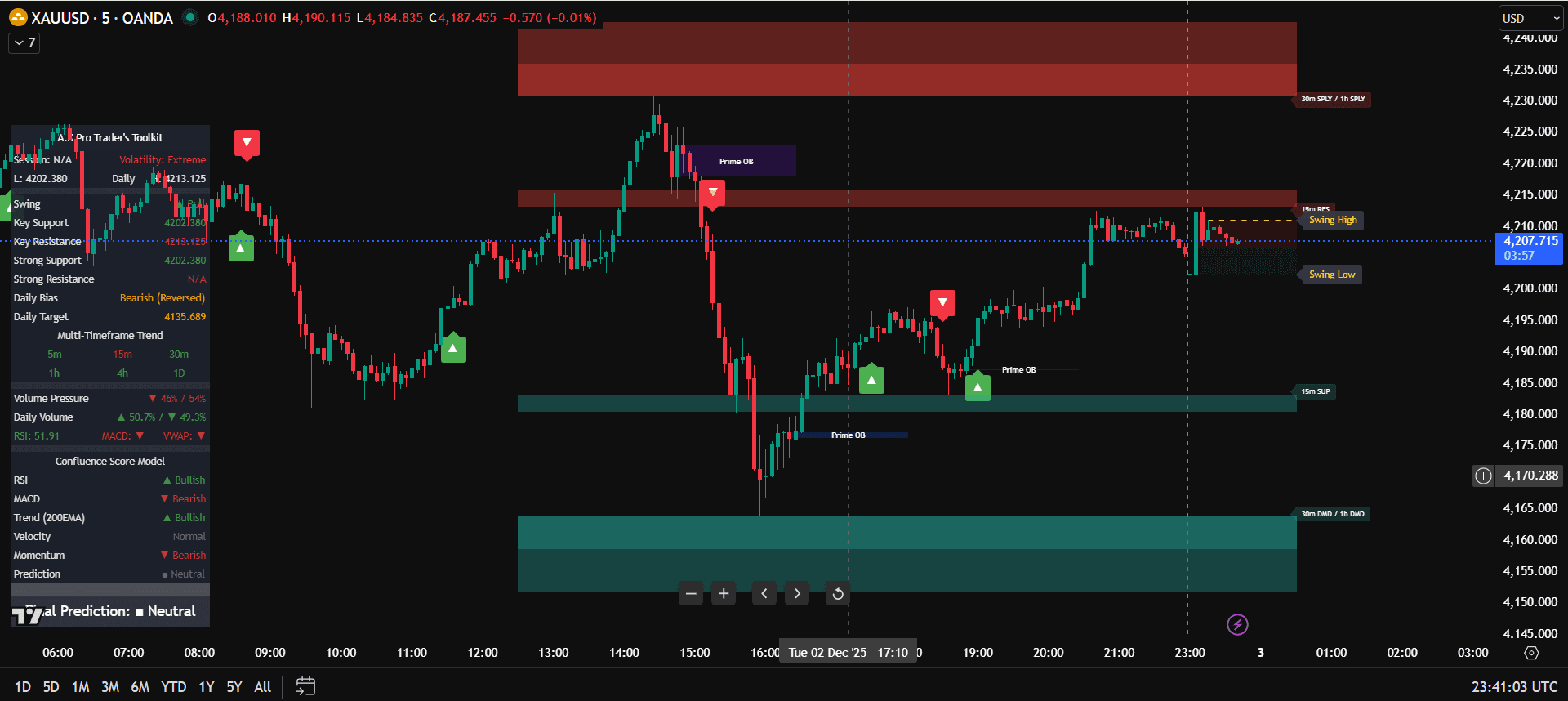
This article supports the main how to use TradingView indicators page by showing how to turn a clean A.K Pro Traders Toolkit chart into a trading workflow. For the main product hub, review the best TradingView indicators for Forex and XAUUSD page. Beginners should also use the TradingView indicators checklist before taking live trades.
Quick answer: use TradingView indicators as a strategy by assigning one tool to bias, one tool to levels or structure, and one tool to confirmation. Enter only when price reaches a planned area and risk is already defined.
The 5-Step TradingView Indicator Strategy
- Define bias: use H4 or H1 to decide whether the market is bullish, bearish, or unclear.
- Mark location: identify key levels, liquidity, support, resistance, or SMC points of interest.
- Wait for price: do not trade in the middle of nowhere. Let price reach the plan.
- Confirm entry: use rejection, BOS, CHOCH, displacement, retest, or your chosen execution filter.
- Control risk: choose invalidation first, then calculate position size and target.
Strategy Example for XAUUSD
A Gold trader can use H1 to define direction, mark the nearest liquidity or key level, then drop to M15 for confirmation. The A.K Pro Traders Toolkit can help organise that process, but the trade is only valid when the chart reaches the planned area and the risk makes sense.
- Bias: H1 is bullish after a clear structure break.
- Location: price pulls back into a previous reaction level or liquidity zone.
- Confirmation: M15 prints rejection and a clean retest.
- Risk: stop goes beyond invalidation and lot size is calculated before entry.
How This Strategy Supports the Main Toolkit Page
This strategy article is one of the supporting pages for the main A.K Pro Traders indicators guide. The main page explains the full setup; this page explains how to turn that setup into a repeatable decision model.
If you need the simple explanation first, read how to use TradingView indicators explained. If you need the pre-trade review, use the TradingView indicators checklist. If the chart is too crowded, clean it with TradingView indicators without overload.
Common Strategy Mistakes
- Using indicators as standalone signals without higher-timeframe context.
- Adding more tools when the real issue is poor risk management.
- Entering before price reaches a planned support, resistance, liquidity, or POI area.
- Changing indicator settings every time one trade loses.
- Ignoring the risk management trading strategy before placing trades.
FAQ: TradingView Indicators Strategy
Can TradingView indicators be a complete strategy?
They can support a strategy, but they should not replace bias, location, confirmation, stop-loss placement, and position sizing.
What is the best indicator strategy for beginners?
The best beginner strategy is simple: higher-timeframe bias, key level or structure, one confirmation rule, and fixed risk.
Why do indicator strategies fail?
They fail when traders take signals without context, overtrade, ignore higher-timeframe direction, or risk too much on one setup.
This guide is educational only and does not constitute financial, investment or trading advice.
Related links
Continue your learning with the most relevant indicator overview and plan options.
General Risk Disclaimer
All A.K Pro Traders content and indicators are provided for educational and informational purposes only and do not constitute financial, investment or trading advice. Trading leveraged products such as forex, indices, commodities and crypto involves substantial risk. Always perform your own research, use appropriate risk management and consider speaking with a licensed financial professional before making any trading or investment decisions.